
Balcony Bliss vs. Condo Bylaws
As the June weather settles into warm summer patterns, thousands of condo owners across the Greater Toronto Area are heading to local garden centers and home decor stores. The goal? Turning that concrete slab outside their sliding glass doors into a personal oasis.
But before you buy that gorgeous over-the-rail planter or a massive patio umbrella, you need to navigate a major piece of paperwork: your building’s condo declaration.
In Ontario, a vast majority of condo balconies are legally classified as Exclusive-Use Common Elements. This means that while you are the only resident with private access to the space, the condo corporation actually owns the physical structure. Because of this, condo boards have a massive say in what you can—and absolutely cannot—do out there.
To help you avoid a mandatory “remove within 48 hours” notice from property management, here is a practical guide to what is typically legal, what is a grey area, and what will instantly violate GTA condo bylaws.
1. The Flooring Trap: Floating vs. Permanent
Bare concrete can feel clinical and cold, making a flooring upgrade the number one priority for most residents.
The Big Violation: You cannot paint, stain, glue, or nail anything directly to the concrete balcony floor. Doing so permanently alters a common element and can trap moisture, causing the concrete underneath to degrade over time.
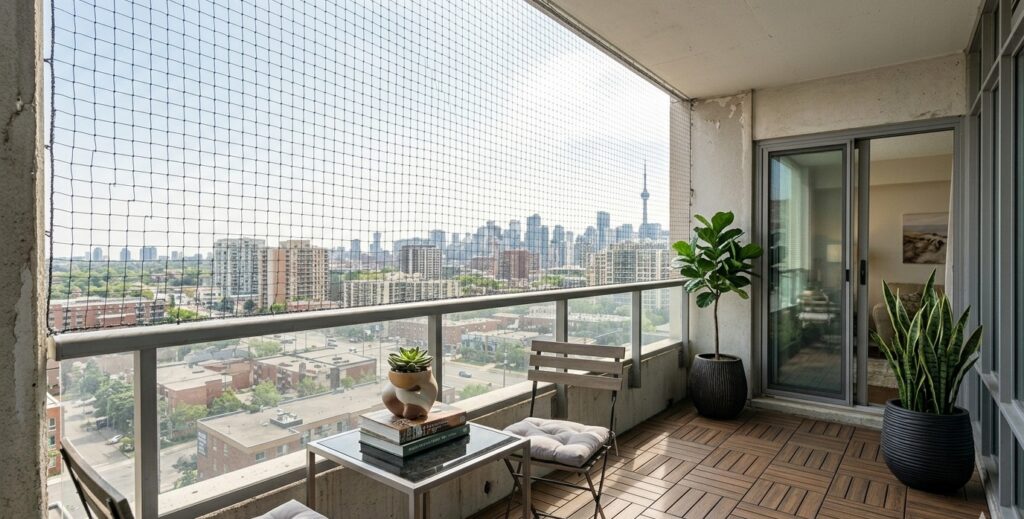
The Legal Loophole: Floating, interlocking deck tiles (whether wood, composite, or porcelain) are your best friend. Because they snap together and rest loosely on top of the concrete without being anchored down, they are completely legal in almost every GTA building. Just ensure they don’t block your floor drain!
2. The Railing Rule: Keep It Inside the Glass
When space is limited, it’s incredibly tempting to look at your balcony railing as extra real estate. However, structural safety and falling object hazards are the top liabilities for high-rise boards.
Never hang planters outward or directly over the rail: Even if a planter claims to be secure, high wind shear at high altitudes can easily dislodge it.
Avoid drilling: You cannot drill screws or hooks into the metal railing or the concrete building envelope to hang privacy screens or string lights.
The Safe Alternative: Use freestanding planter boxes, tiered plant stands, or heavy floor pots. If you want to hang string lights, weave them loosely through the vertical railing bars without damaging the metal finish, or use suction hooks on your exterior windows.
3. The "Uniform Building Aesthetics" Mandate
Many GTA condo owners are surprised to learn that their building has strict rules about color palettes. Under section 98 of the Ontario Condo Act, boards have the right to maintain a uniform appearance for the building’s exterior.
Check the curtain/furniture rule: Many corporations dictate that any umbrella, outdoor privacy panel, or even the backing of your indoor living room curtains must be a neutral color (usually white, beige, grey, or black).
Why it matters: A patchwork of bright red, neon green, and hot pink umbrellas scattering the side of a glass high-rise ruins the architectural uniformity of the building. Before investing in major decor pieces, check your status certificate or rulebook for color restrictions.
📜 Condo Balcony Bylaw FAQ
Here are the answers to the most common legal and practical questions asked by GTA condo residents:
What happens if I ignore a warning from Property Management about my balcony decor?
If property management flags a violation (like a prohibited BBQ or an unapproved storage box), they will issue a formal written request to remove it. If you ignore it, the condo corporation’s legal counsel will send a formal demand letter. Under Ontario law, the cost of hiring that lawyer to write the letter can be legally added directly to your monthly common element fees (maintenance fees). If left unpaid, it can result in a lien being placed against your unit.
Are electric BBQs always allowed on GTA condo balconies?
While Ontario’s fire code generally allows electric BBQs on balconies (and strictly bans propane and charcoal options due to open-flame risks), individual condo corporations have the final say. Many GTA buildings explicitly ban all forms of outdoor cooking in their rules to prevent smoke, odors, and grease particles from drifting into neighboring units’ open windows. Always check your specific building rules before buying one.
Can I install a pet relief grass pad on my balcony?
Real or synthetic grass dog patches are a major grey area. While the pad itself isn’t altering the structure, the rules regarding nuisance and sanitation apply. If urine leaks through the pad onto the concrete floor, it causes odor issues and can drip down to lower balconies. If you use one, it must be completely leak-proof, cleaned daily, and positioned so it cannot be seen or smelled by neighbors.
Can my condo board ban me from growing vegetables or plants on my balcony?
A board cannot completely ban you from having potted plants, but they can limit the weight and quantity. Soil and heavy ceramic pots add up to significant weight. If your balcony accumulates hundreds of pounds of soil, it can pose a structural weight-bearing risk. Stick to lightweight plastic or resin pots and spread them out evenly across the floor space rather than clustering them all in one spot.